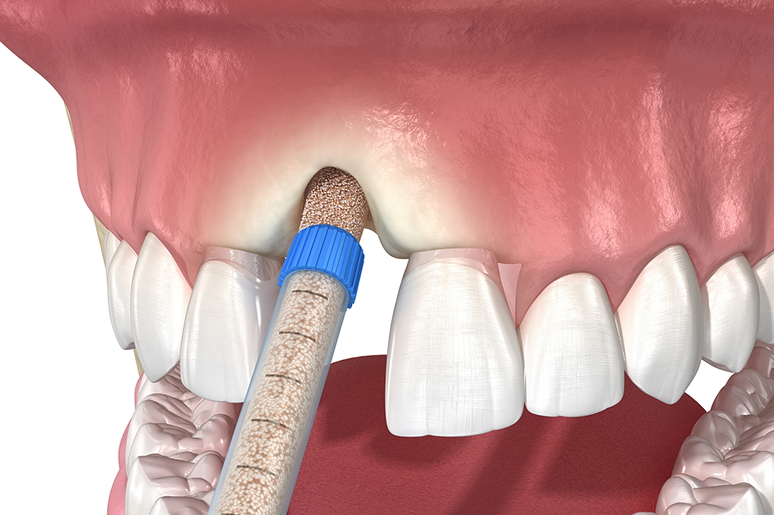
When a tooth has been missing for a while, the jawbone beneath it can thin out. Bone grafting helps rebuild that support so a dental implant has a stable foundation, planned with 3D imaging at our Los Angeles office.
WHY BONE MATTERS
Tooth roots do more than hold teeth in place. Chewing forces travel through them into the jaw and help keep the surrounding bone in use. When a tooth is lost, that stimulation stops, and the ridge of bone that held it often begins to shrink in width and height over time. How quickly this happens varies from person to person.
A bone graft places supportive material where bone has become thin. As you heal, your body gradually forms new bone in and around the graft, which can create enough volume to hold a dental implant. For some patients, grafting is the first step toward replacing a tooth that has been missing for some time.
GRAFTING OPTIONS
The approach depends on where bone is missing, how much is needed, and the type of tooth replacement you're planning. Your dentist will walk you through the options that fit your situation.
Graft material is placed into the empty socket right after a tooth is removed. This can help limit the shrinkage that often follows an extraction and may reduce the need for a larger graft later if you plan on an implant.
When the jaw ridge has already narrowed or lost height, graft material can be added along the ridge to rebuild its shape. The area is often covered with a protective membrane while it heals.
For larger defects, a solid piece of graft bone may be secured to the jaw so it can fuse with the existing bone over time. Larger grafts like this generally need a longer healing period before an implant can be placed.
A thin barrier membrane is placed over the graft to keep faster-growing gum tissue out of the space, giving new bone room to fill in. GBR is commonly combined with other grafting techniques.
Bone height in the upper back jaw can be limited by the sinus that sits above it. A sinus lift raises the sinus floor and adds graft material underneath. Learn more on our dedicated Sinus Lift page.
When bone loss is minor, a small graft can sometimes be placed during the same visit as the implant, which may shorten the overall timeline. Your 3D CBCT scan helps your dentist decide whether this is an option for you.
GRAFT MATERIALS
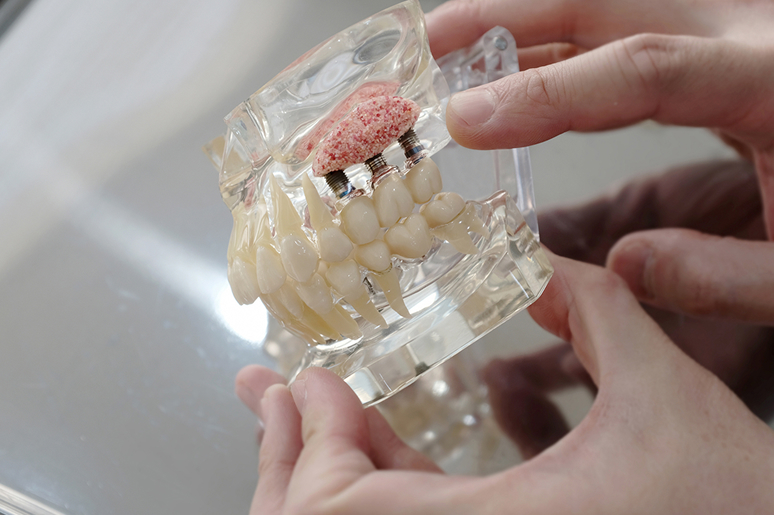
Graft materials come from several sources. Each one acts as a framework that your own bone can gradually grow into as you heal.
Your dentist will recommend a material based on the size and location of the area being treated and your implant plan, and answer any questions you have about it.
WHY TRUSTED DENTAL
A graft is one step in a larger plan. At our Los Angeles office, we map out the graft, the healing period, and your implant restoration together so you know what to expect at each stage.
Cone beam CT imaging shows the width, height, and shape of your jawbone in three dimensions, helping your dentist decide whether a graft is needed and which approach fits your anatomy.
Dr. Tyler Ghadoushi's practice focuses on restorative care, including implants, crowns, bridges, and dentures, so your graft is planned with the final tooth replacement in mind.
Treatment is done with gentle local anesthesia and relaxed pacing. Nitrous oxide is available if you'd like help staying calm, and we explain each step before we begin.
Costs depend on the type and size of graft. We review your estimate, verify PPO benefits, and can discuss CareCredit, Sunbit, Cherry, or in-house payment plans for qualifying treatment.
COMMON QUESTIONS
What patients ask most about jawbone loss, graft materials, and healing before dental implants.
Not always. Many patients have enough bone to place an implant without grafting. A 3D CBCT scan lets your dentist measure the bone at each planned implant site, and if it's too thin, a graft may be recommended first or, in some cases, during the same visit as the implant.
Most patients find it similar to recovering from a tooth extraction. Some soreness and swelling are common for the first few days and are usually managed with over-the-counter or prescribed pain relief. Your dentist will give you instructions for protecting the graft site while it heals.
Healing time varies by patient and by graft. Smaller grafts often need around four to six months, while larger grafts can take longer. Your dentist checks healing with follow-up visits and imaging before scheduling implant placement.
Graft material may come from your own body, a human tissue bank, a purified animal source, or a synthetic substitute. Donor and animal-derived materials are processed and sterilized before use. Your dentist will explain which option is recommended for you and why.
If you think you may want an implant later, it's worth asking. A socket preservation graft placed at the time of extraction can help limit bone shrinkage while the area heals. You can read more about the removal itself on our tooth extractions page.
The bone where the tooth used to be often continues to shrink, and nearby teeth may drift into the space. Waiting doesn't always rule out an implant, but it can mean a larger graft is needed first. An exam with 3D imaging at our Los Angeles office can show where your bone stands today.
Schedule a visit at our Los Angeles, CA office. We'll evaluate your jawbone with 3D imaging, explain whether grafting makes sense for you, and outline the next steps toward your implant.