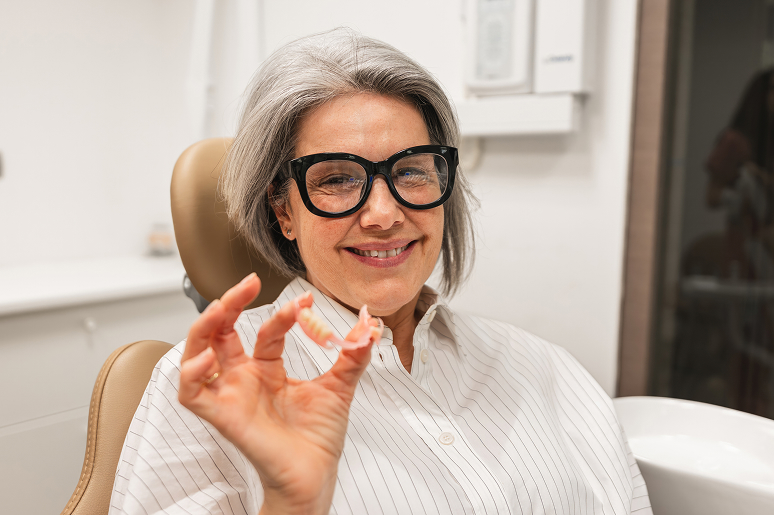
Whether you're missing a few teeth or a full arch, a well-fitted denture or partial can help you chew, speak, and smile with more confidence. Our Los Angeles team helps you compare options and fine-tune the fit as you adapt.
PERSONALIZED TOOTH REPLACEMENT
A full (complete) denture replaces all the teeth in the upper or lower arch and rests on the gums. A partial denture fills gaps when some healthy natural teeth remain, attaching to them with clasps or a framework so those teeth help hold it in place.
Your dentist will look at your remaining teeth, gums, and bone, along with your budget and goals, before recommending an option. Dr. Tyler Ghadoushi's restorative focus includes dentures, implants, crowns, and bridges, so you can compare approaches in one conversation.
DENTURE OPTIONS
The right option depends on how many teeth are missing, the health of your remaining teeth and gums, and your budget.
Replace every tooth in the upper arch, lower arch, or both. An upper denture often gains suction from the palate, while a lower denture relies more on the gum ridge and surrounding muscles.
Fill one or more gaps when healthy natural teeth remain. A framework with clasps attaches to nearby teeth to keep the partial steady, and it comes out for cleaning.
Made ahead of time and placed on the day teeth are removed, so you don't go without teeth while healing. As the gums change, adjustments or a reline are usually needed.
A denture that clips onto dental implants for more stability than a denture resting on the gums alone. Many patients find they rely less on adhesive.
Made from a flexible, gum-colored material without visible metal clasps. They can be a comfortable choice for some patients, though they aren't right for every situation.
As gums and bone change over time, a denture can loosen. A reline reshapes the inside surface for a better fit, and many cracks or broken teeth can be repaired.
UPGRADE YOUR DENTURE
Often, yes. Implant-supported dentures attach to dental implants placed in the jaw, which can make them feel more secure for eating and speaking than a conventional denture. Learn more on our implant-supported dentures page.
Whether it's a good fit depends on your bone, overall health, and goals. A 3D cone beam CT scan helps your dentist check the available bone, and in some cases a graft may be suggested first.

WHY CHOOSE TRUSTED DENTAL
Getting used to a new denture takes time. We focus on fit, comfort, and clear guidance so the adjustment period goes as smoothly as possible.
Records, try-ins, and a delivery visit let you see and feel your denture before it's finished, with changes made along the way.
Sore spots and pressure points are common at first. Follow-up visits let us fine-tune the fit as your mouth gets used to the denture.
Implants and dentures are both part of Dr. Ghadoushi's restorative focus, so an implant-supported upgrade can be planned when you're ready.
We verify PPO benefits and file claims, and financing through CareCredit, Sunbit, or Cherry is available for qualified applicants.
COMMON QUESTIONS
Common questions about getting used to dentures, caring for them, and when to consider an upgrade.
It usually takes several appointments over a few weeks, including records, a try-in, and delivery. The exact timeline depends on your case and whether any teeth need to be removed first. Immediate dentures are made in advance so they can be placed on the day of extraction.
Denture teeth come in many shapes and shades, and your dentist will select ones that suit your face, smile, and any remaining natural teeth. The try-in visit gives you a chance to see the look and request changes before your denture is finished.
Rinse your denture after meals and brush it daily with a soft brush and a denture cleaner, since regular toothpaste can be abrasive. Most dentists recommend taking dentures out at night and keeping them moist in water or a soaking solution. Brush your gums, tongue, and any natural teeth as well.
Many dentures last several years with good care, but the lifespan varies by patient. The gums and bone under a denture change over time, so a reline or replacement may eventually be needed. Regular checkups help catch fit problems early.
Some looseness, sore spots, and extra saliva are common in the first few weeks while your mouth adjusts. Speaking and chewing usually feel more natural with practice. If a sore spot doesn't improve, call us for an adjustment rather than trying to fix the denture yourself.
Many PPO dental plans include some coverage for full and partial dentures, but benefits and limits vary. Our team can verify your coverage and file claims for you. In-house payment plans may also be available for qualifying treatment.
Sometimes. Depending on the design, a tooth can occasionally be added to an existing partial, while other situations call for a new one. Bring your partial to a visit at our Los Angeles office, and your dentist can tell you which option makes sense.
Visit our Los Angeles office to compare full dentures, partials, and implant-supported options. We'll review your goals, budget, and benefits and help you choose your next step.