Wisdom teeth don't always have room to come in properly. At our Los Angeles office, we evaluate them with digital X-rays and 3D imaging when needed, and recommend removal when they're causing problems or likely to.
ABOUT WISDOM TEETH
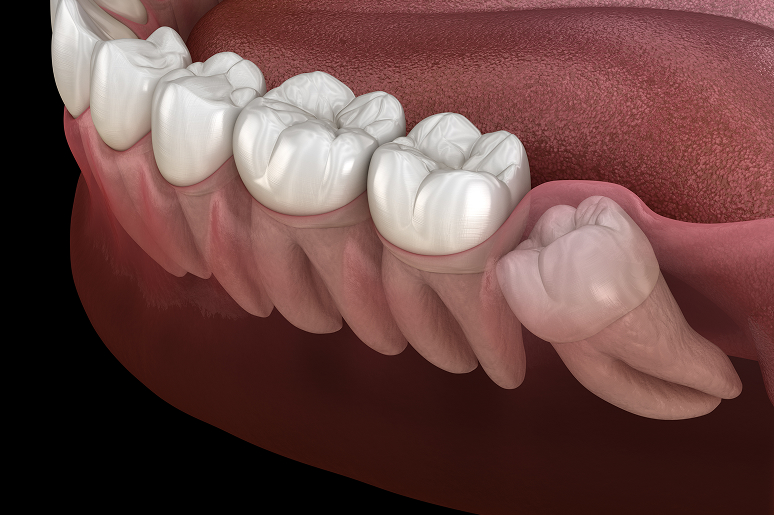
Wisdom teeth are the third molars, the last teeth to develop, and they often start coming in during the late teens or early twenties. When there isn't enough room at the back of the jaw, a wisdom tooth may stay trapped in the bone or gum, break through only partway, or grow in at an angle toward the neighboring molar. This is called impaction.
Some wisdom teeth come in straight and stay healthy. Others cause trouble gradually, so checkups and imaging help your dentist spot problems early. For an overview of how extractions work in general, see our tooth extractions page.
FROM EVALUATION TO RECOVERY
Every case starts with an evaluation. Here's what the process typically looks like if your dentist recommends removal.
Digital X-rays show the position of each wisdom tooth. When roots sit close to a nerve or the sinus, a 3D cone beam CT scan gives your dentist a clearer view before planning.
Local anesthesia numbs the area. Nitrous oxide is available if you'd like help relaxing, and we'll talk through your comfort options ahead of time.
If a tooth is still under the gum or bone, a small opening provides access. The tooth may be divided into sections so it can come out with less disturbance to the bone.
After removal, the area is cleaned and stitches may be placed. Gauze helps a protective blood clot form, which is an important part of healing.
You'll leave with written instructions on swelling, diet, and gentle cleaning, plus guidance on managing discomfort and how to reach our office.
A follow-up visit lets your dentist check how the sites are healing and remove any stitches that don't dissolve on their own.
RECOVERY TIMELINE
Recovery depends on how many teeth were removed and whether they were impacted. Swelling and jaw stiffness are common and often peak around the second or third day before gradually easing. Many patients feel close to normal within about a week, though this varies.
Planning a few quiet days, especially around school or work, makes recovery easier. Following your aftercare instructions and keeping your follow-up visit help things stay on track.

WHY CHOOSE TRUSTED DENTAL
We focus on careful evaluation, honest recommendations, and a comfortable visit, whether you're in high school or well into adulthood.
Cone beam CT scans show how roots relate to nearby nerves and the sinus, helping your dentist plan a careful approach for complex cases.
Local anesthesia and nitrous oxide help you stay relaxed. We work at a calm pace and check in with you throughout the visit.
With general dentistry and orthodontics in one office, wisdom teeth can be reviewed alongside braces or aligner plans when timing matters.
If questions come up while you're healing, call our office. Our team can explain what's normal and schedule a check if needed.
COMMON QUESTIONS
Common questions about impacted wisdom teeth, timing, and recovery for teens and adults.
No. Wisdom teeth that have fully come in, are well positioned, and can be cleaned properly may be fine to keep. Your dentist will evaluate each tooth and explain whether removal, monitoring, or no treatment is recommended.
Many dentists like to check wisdom teeth in the mid to late teens, when X-rays can show how they're developing. If removal is needed, it's often done in the teen or young adult years, when roots are still forming and healing tends to be smoother. Adults can still have wisdom teeth removed when needed.
You often can't tell on your own, because impacted teeth can sit below the gums without symptoms. Possible signs include pain or swelling at the back of the jaw, tender gums, or a bad taste near the back molars. X-rays, and sometimes a 3D scan, are the reliable way to know.
Often, yes, depending on how the teeth are positioned and what feels comfortable for you. Removing them together can mean a single recovery period instead of several. Your dentist will recommend an approach after reviewing your images.
Many patients plan for a few days of rest, especially after removing impacted teeth. Classes or desk work are often possible sooner than physically demanding activities. Your dentist can give you a better estimate once your treatment plan is set.
Many PPO dental plans include some coverage when removal is recommended for a clinical reason, though benefits vary. Our team can verify your coverage before treatment and file claims for you. Financing through CareCredit, Sunbit, or Cherry is also available for qualified applicants.
Some impacted teeth cause no problems for years, while others may lead to gum infections, decay on the neighboring molar, or, less commonly, cysts. If you decide to keep them, your dentist will typically suggest monitoring them with periodic X-rays at your checkups in our Los Angeles office.
Request a visit at our Los Angeles office. We'll check how your wisdom teeth are developing, explain what we see on your images, and give you a clear plan before anything is scheduled.